

The causes of childhood lymphoma remain poorly understood. Unlike many other childhood cancers, lymphoma comprises a group disease that includes two main subtypes: Hodgkin lymphoma and non-Hodgkin lymphoma. These subtypes differ in their biology and etiology. Early-life environmental exposures and birth characteristics have long been proposed as potential contributors to lymphoma risk.
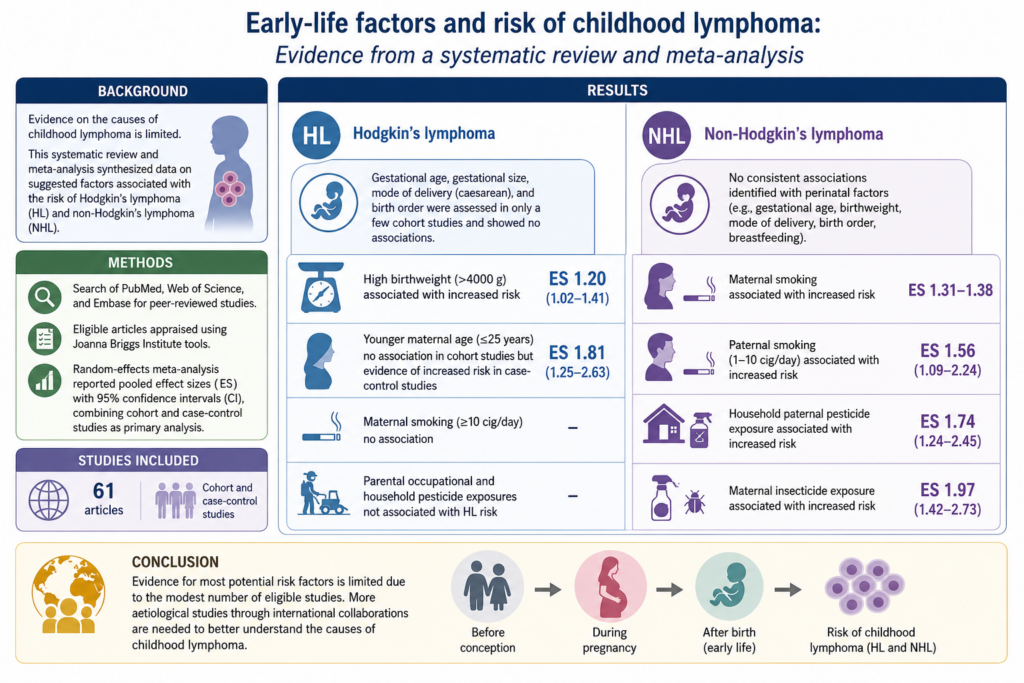
Researchers from the International Agency for Research on Cancer (IARC) conducted a systematic review and meta-analysis examining the current evidence on early-life environmental risk factors for childhood lymphoma in different exposure periods. Overall, the study found that most factors including birth-related characteristics, such as gestational age, mode of delivery, birth order, and breastfeeding duration showed no consistent association.
For Hodgkin lymphoma, high birthweight showed the clearest signal. Children with birthweight above 4,000 grams had a modestly higher risk of Hodgkin lymphoma compared with children of lower birthweight. One possible explanation is that high birthweight may reflect growth-related conditions before birth, including hormonal or metabolic factors, although the biological mechanisms remain unclear.
For non-Hodgkin lymphoma, parental smoking was associated with a slightly increased risk. Furthermore, household pesticide and insecticide exposure emerged as potential risk factors. These findings are biologically plausible because early development may be a sensitive window for chemical exposures, including those that could affect the immune system or developing blood cells.
The evidence remains limited overall, nonetheless. Childhood lymphoma is rare, and many of the exposures examined in the review were investigated in only a small number of studies. Some findings, especially those related to smoking and household pesticide use, came mainly from studies relying on retrospective observational studies, which can be prone to bias and should therefore be interpreted cautiously.
Findings of this recent review suggest that much remains uncertain about the causes of childhood lymphoma. Yet, they highlight several exposures that deserve closer attention. Larger international studies with detailed exposure information will be important to clarify whether these associations reflect causal effects, chance findings, or differences between study populations. By synthesizing the available evidence, this review helps refine the direction for childhood lymphoma research. It shows where evidence is beginning to accumulate, where uncertainty remains, and why international collaborations are essential for studying rare childhood cancers.
Citation:
Article Title: Early life environmental exposures and birth characteristics and childhood lymphoma risk: a systematic review and meta-analysis
Authors: Roya Dolatkhah, Felix M Onyije, Liacine Bouaoun, Ann Olsson, Joachim Schüz
Published In: Journal of the National Cancer Institute, djag136. Advance online publication. https://doi.org/10.1093/jnci/djag136