

Despite remarkable advances in the treatment of B-cell acute lymphoblastic leukemia (B-ALL), racial/ethnic disparities in incidence and outcomes persist, suggesting inherited genetic differences in leukemia susceptibility and prognosis. Although African American children experience a lower incidence of B-ALL compared to other racial/ethnic groups, their clinical outcomes are significantly worse. These differences are not fully explained by perinatal risk factors or socioeconomic status. To address this gap, CLIC researchers conducted the largest genome-wide association study (GWAS) of B-ALL among children of African ancestry to date, leveraging multi-institutional datasets that included 840 African American cases and 3,360 controls.
The study results revealed that the genetic architecture of B-ALL risk in African American children is similar to that observed in other ancestries yet is also distinct from them. Single nucleotide polymorphisms (SNPs) found in predominantly European cohorts replicated robustly among African American children, with comparable effect sizes. However, the frequency of these transethnic risk alleles is mostly lower, which gives a partial explanation for the lower risk of ALL in African American children.
The study identified seven novel variants specific to African ancestry, which fit a remarkable pattern: low allele frequency (<0.10), large odds ratios (>1.8 per allele), and high evidence of regulatory function in blood. These variants might be anti-malaria adaptations among African ancestors, which also have ALL as a very rare side effect.
These findings help elucidate longstanding epidemiologic patterns of ALL incidence across the United States which shows higher incidence in the US Southwest, with a high proportion of Latino children with higher risk, and lower incidence in the US Southeast, with a higher proportion of Black children with lower risk. (We speculate that higher incidence in the US Northeast may be due to with higher parental age on average: https://www.nytimes.com/interactive/2018/08/04/upshot/up-birth-age-gap.html)
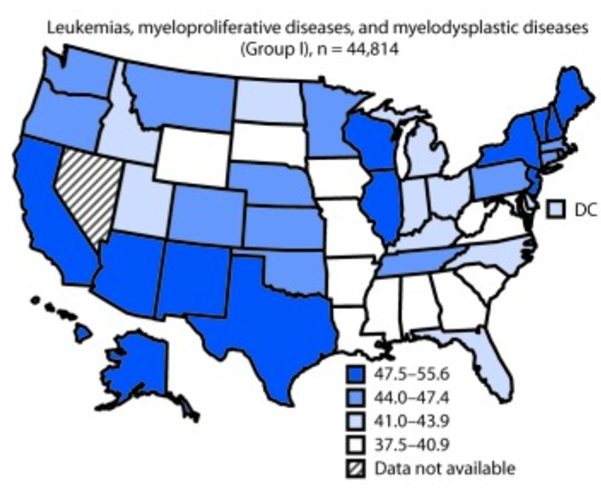
Source: https://pubmed.ncbi.nlm.nih.gov/29953430/
While the pattern of ALL incidence in relation to demographics could be due to environmental factors, the parsimonious explanation is that these patterns are due to common variants that have differing frequencies in populations (and in some cases, are population-specific).
Another notable finding in the study is that the novel African ancestry-specific alleles were associated with worse survival. This guides the way towards better outcomes for patients with substantial African ancestry.
By illuminating how ancestry shapes both disease risk and outcomes in childhood B-ALL, this new CLIC study underscores the critical importance of GWAS in childhood cancer research. Ultimately, integrating such results into clinical care has the potential to improve risk prediction, tailor treatment strategies, and reduce disparities in survival outcomes for all children affected by B-ALL. We at CLIC are proud to be one of the world’s pioneers in driving discoveries that bring us closer to better understanding childhood leukemia risk and survival.
Citation:
Article Title: Genome-wide association study of childhoodB-cell acute lymphoblastic leukemia revealsnovel African ancestry-specificsusceptibility loci
Authors: Cindy Im , Andrew R. Raduski, Lauren J. Mills, Kashi Raj Bhattarai , Robert J. Mobley, Kelly R. Barnett, et al.
Published In: Nat Commun. 2025 Oct 22;16(1):8974. doi: 10.1038/s41467-025-64337-7.