

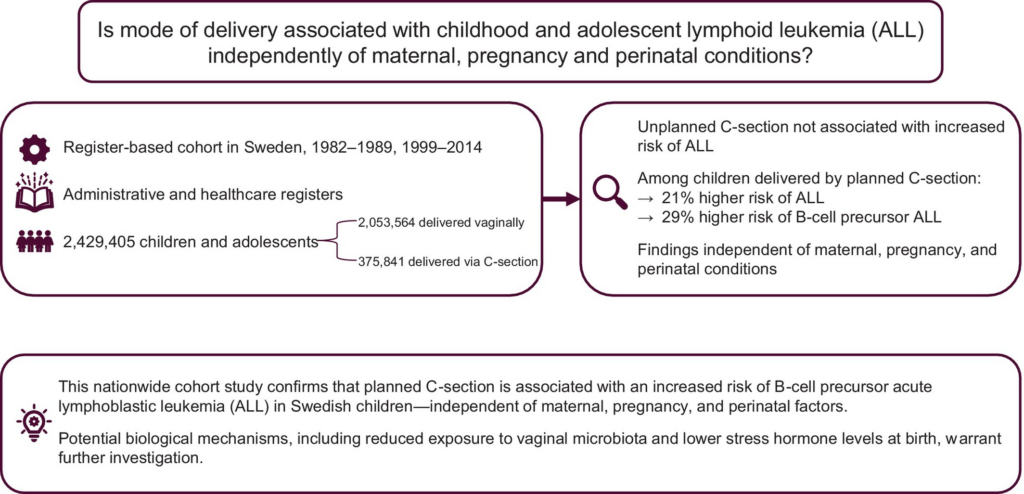
Childhood acute lymphoblastic leukemia (ALL) has been widely postulated to originate before birth through early genetic lesions, followed by postnatal immune triggers. One of the most intriguing clues about this immune component emerged nearly a decade ago, when researchers from CLIC reported that children born by planned cesarean section (CS) had a higher risk of ALL than those born vaginally or by emergency cesarean delivery. Now, a new nationwide study from our partners at Karolinska Institutet in Sweden provides the strongest confirmation to date about this association.
The Swedish team analyzed more than 2.4 million children born between 1982 and 2015, linking detailed birth records with national cancer registries, using prospectively collected and standardized data. The study was able to comprehensively account for maternal, pregnancy, and offspring conditions that may influence both delivery mode and childhood leukemia risk, including maternal diabetes, pre-eclampsia, infections during pregnancy, congenital anomalies, and fetal macrosomia. It also distinguished pre-labor planned CS from emergency CS performed after labor had begun.
Over follow-up, 1,183 children developed ALL, including 952 cases of B-cell precursor ALL. In direct agreement with earlier findings, planned pre-labor cesarean delivery was associated with a significantly increased risk of childhood leukemia, while other forms of cesarean delivery were not. Specifically, children born by planned CS had a 29% higher risk of B-cell precursor ALL compared with vaginally delivered children (HR = 1.29; 95% CI 1.01–1.67). This association remained largely consistent after adjustment for maternal, pregnancy, and perinatal conditions, with only small attenuations observed (adjusted HR = 1.25; 95% CI 0.97–1.62). The association was strongest in children diagnosed before age 5, the peak age of ALL incidence (B-cell precursor ALL adjusted HR = 1.35; 95% CI 1.02–1.80), and was absent for emergency or post-labor cesarean delivery.
This Swedish study directly extends CLIC’s landmark pooled analysis, identifying the link between pre-labor cesarean delivery and ALL risk. By using nationwide prospective registers and detailed obstetric information with minimal bias, the Karolinska study adds critical depth, showing that the association is robust, biologically specific, and unlikely to be explained by confounding by indication—a longstanding concern in this research area.
Together, these studies strengthen the evidence that bypassing labor may alter early immune development in a way that increases susceptibility to childhood leukemia. While the absolute risk for any individual child remains small, the findings suggest that non-medically indicated planned CS may carry measurable long-term risks, reinforcing the importance of carefully weighing elective CS against its potential consequences for lifelong health.
Citation:
Article Title: Mode of delivery and the risk of lymphoblastic leukemia during childhood-A Swedish population-based cohort study
Authors: Kampitsi CE, Mogensen H, Heyman M, Feychting M, Tettamanti G.
Published In: Int J Cancer. 2025 Nov 15;157(10):2041-2048. doi: 10.1002/ijc.70027.